A Season in Rehearsal: Russia’s 2026 Test Skates in Moscow
At the CSKA Arena, Alexandra Ignatova’s quad Lutz brought the crowd to its feet. Elsewhere, ambitious new stories met the less forgiving reality of September form.
Moscow, 19–20 September 2026. There were no scores to chase and no medals to collect at Russia’s national team test skates. The point of the two-day event was to show work in progress: Short Programs and Rhythm Dances on Saturday, Free Skates and Free Dances on Sunday. Yet the atmosphere at the CSKA Arena felt anything but casual. For athletes returning from long absences, changing coaches or pursuing a place on the international circuit, a September exhibition could carry the weight of a first verdict.
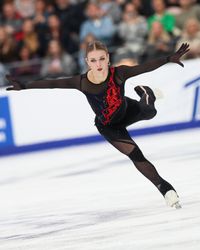
The women’s event supplied the most compelling contrast. Alexandra Trusova who now competes as Ignatova, started the free skate with a clean quadruple Lutz in her Stranger Things program that held together from first element to last. The audience rose to applaud. Her return after becoming a mother has inevitably been framed as a test of whether the “Russian Rocket” can recapture her Beijing-era arsenal. Ignatova offered a more measured answer: she said she had been nervous even without scores, was glad the skate worked, and considered her current condition “very good for September.” She also made clear that the body with which she once attempted five quads is not a benchmark she expects to reproduce.
Her choreographer, Daniil Gleikhengauz, described a training schedule that now adjusts to fatigue and family life. “Sasha is a completely different person now,” he told the Russian Olympic Committee, while stressing that her appetite for the highest level has remained. The program’s success made the point more persuasively than any prediction about how many quads she might eventually add.

For Kamila Valieva, the weekend was a more fragile stage in a comeback, just shortly after she was banned again from competing and is pursuing legal action. Benoît Richaud’s short program to Ludovico Einaudi’s “Mamma la Rondinella” let her movement and expressiveness come through, even as her jumps showed the gap between performance quality and competitive readiness. Her free skate, set to Max Richter and inspired by the movie “Hamnet”, unravelled after an aborted quad toe loop and a fall on a triple flip. Valieva left the ice in tears. “Some people deal with (the emotion) quickly, but I will need much more time, judging by today,” she told reporters. She said the skate had shown her what needed work.
Richaud, who choreographed both Valieva’s programs, urged patience. He said the Valieva he sees in training is recovering her quality and strength, and that “the body, the mind and the heart” sometimes need time to arrive in the same place. Valieva herself spoke about the free skate as a story of pain giving way to something beautiful. It is an evocative artistic idea; at CSKA Arena, it remained an unfinished competitive one.
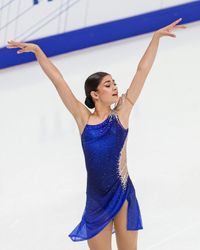
Adeliia Petrosian’s first public performances under new coach Inna Goncharenko offered another kind of reset. Her short program used a cover to Queen’s “The Show Must Go On”; the free program cast her as Arya Stark to Ramin Djawadi’s “Game of Thrones” music. The character suited her forceful attack, but the jumps did not yet match the dramatic ambition. Petrosian, who said she was skating while slightly unwell, explained that Sunday was the first time she had run the entire free program. Goncharenko has described her decision to continue competing as a conscious choice. These were the beginnings of a new partnership, rather than a finished product.
Beyond the headline names, there were programs worth following for their own sake. Anna Frolova brought an emotionally direct “Titanic” free skate, although a late stumble disrupted the ending. Kamilla Neliubova’s darker free program showed pace and control despite a step-out on the triple Axel. Alina Gorbacheva, returning from injury, kept her Notre-Dame de Paris free skate and used a reduced jump layout. The variety was a reminder that the women’s field is broader than its three biggest stories.
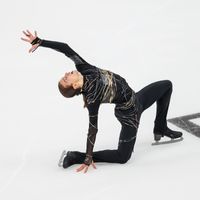
The men answered theatrical ambition with formidable technical content. Petr Gumennik’s Hamnet free skate included a monologue from Shakespeare’s Hamlet, recorded by Yura Borisov, an Oscar nominee for his supporting role in Anora. Gumennik attempted five quads, successfully executing four different types, but an error stopped him adding the intricate combination he had planned. “I was afraid of making a mistake, and that fear let me down a little,” he said afterwards. Gleb Lutfullin, by contrast, delivered five quads in a striking fallen-angel program that mixed “Like a Prayer” with music from “Tosca”. Mark Kondratiuk who was like Valieva banned again from competing offered perhaps the weekend’s boldest musical collision: Chopin’s Nocturne No. 20 giving way to Gangsta’s Paradise. He explained it as a program about the freedom to choose and to be oneself.
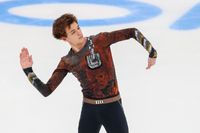
Vladislav Dikidzhi brought an exhilarating creative range to his programs, pairing the playful musicality of his Amélie and Einaudi short with the arresting imagery of Edvard Munch’s The Scream and the driving percussion of Feeling the Sound in his free skate. Fresh from victory at the Kinoshita Group Cup in Tokyo, he already looks every inch one of the team’s leaders, combining formidable jumping with the imagination and character to make his performances unmistakably his own.
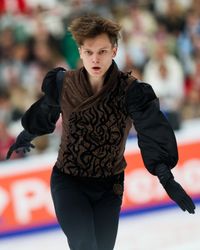
Evgeni Semenenko’s The Count of Monte Cristo and Grigorii Fedorov’s Michael Jackson short supplied two more distinct personalities.

In pairs, the familiar rivalry already had a new-season edge. Aleksandra Boikova/Dmitrii Kozlovskii landed a quadruple throw in their Carmen free skate, accepting risk even after a run of early-season appearances abroad.
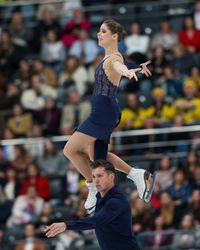
Anastasiia Mishina/Aleksandr Galliamov brought back established programs and the security of their synchronized elements, including a triple Salchow–triple Salchow combination. Galliamov said the test skates had helped them identify what to change after consulting technical specialists. One team made its case through a spectacular element; the other through accumulated polish.
Ice dance brought both elegant possibilities and a sobering reminder of how quickly plans can change. Elizaveta Pasechnik/Dario Cirisano chose a classical waltz feel for their rhythm dance;
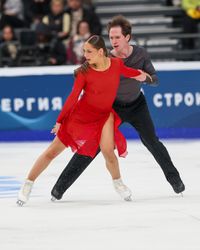
Irina Khavronina/David Narizhnyi returned to public performance after a long break with a contemporary take on “To Build a Home”. But Vasilisa Kaganovskaia/Maksim Nekrasov withdrew after a collision with Anna Shcherbakova/Egor Goncharov during the rhythm-dance warm-up. Coach Alexei Gorshkov later reported that an MRI showed a dislocation, with no fracture or ligament damage. Pasechnik/Cirisano subsequently closed the free dance with a missed lift: another reminder that a promising September idea still has to survive its full run-through.
Text: Natalia Boku
Photos: Olga Timokhova
Find more of Olga's photos from the Test Skates on our website here and in Olga's Telegram Channel.